
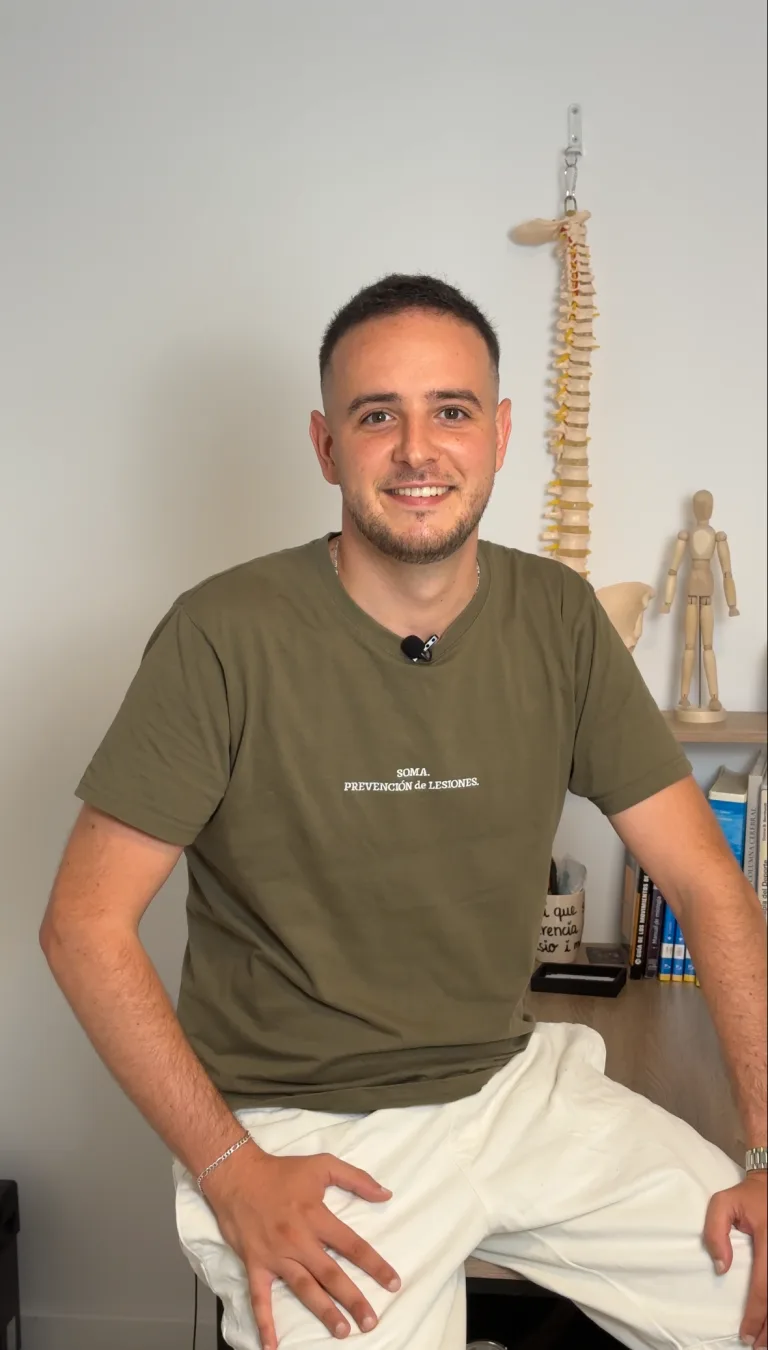
Roger Pont Bosch, physiotherapist
SOMA. Prevención was born in 2019 from a simple idea: back pain isn't treated with a one-off session — it's accompanied through a process.
Roger Pont Bosch (1997) has been a physiotherapist since age 18, trained at the International University of Catalonia (UIC) with a focus on rehabilitation and movement optimization. He has also trained with Carlos Lorenzana, at Kine Method Therapies by Carlos Lorenzana, where he deepened his knowledge of spinal care. He balances his private practice with sports projects and collaborates in surgical interventions alongside a medical team, following the process from the operating room to functional recovery.
Today SOMA. Prevención sees patients in person in Sant Andreu de Llavaneres, Premià de Dalt and Barcelona, and online anywhere in the Spanish-speaking world.
How we understand the body today
For decades, taking care of the body meant one very specific thing: when something hurt, you treated it. You got injured, saw a professional, they relieved the pain, and you went back to your life until the next time. And it worked. A whole generation of professionals did enormous work with the knowledge and tools of their time, and we owe much of what we know today to them.
But our knowledge of the human body hasn't stood still. It has advanced. And with it, our understanding of what it truly means to care for a person.
Today we know something that changes everything: the body doesn't work in separate pieces. What hurts in one place is often born somewhere else. A stiff area, certain habits, too many hours sitting, the way you move every day — it's all connected. That's why looking only at the point that hurts stays on the surface. At SOMA. Prevención we look at the whole picture: where the problem comes from, not just where it shows up.
And we also know that removing pain isn't the end of the work — it's the beginning. Relieving discomfort gives you back today's wellbeing, but if the body stays just as weak, just as stiff, moving the same way, the problem comes back. That's why movement, well-guided exercise, and nutrition are no longer optional extras: they're part of care. Not for once you're better, but from day one.
This is the evolution society as a whole has gone through. Today we're all more aware that the body is cared for by moving it, feeding it, and understanding it — not just repairing it when it breaks. Newer generations take this for granted. And that's exactly where we work from.
Because caring for the body, properly understood, isn't a one-off act: it's a relationship that lasts a lifetime. The body, if you stop attending to it, moves backward. Keeping it strong, mobile, and pain-free isn't a luxury or an obsession — it's the best investment in how you'll move, and live, over the next ten, twenty, or thirty years.
That's SOMA. Prevención. We don't treat isolated symptoms: we help people understand their body, recover it, and care for it so the change is real and lasting. With respect for everything that was done before, and everything we know how to do better today.
Where to find us
Message us and let's talk about your back
No booking forms, no commitment. You write to us, we ask what's going on, and we explain how we can help.
Message BACK on WhatsApp